18: A Little Taste of the Glory
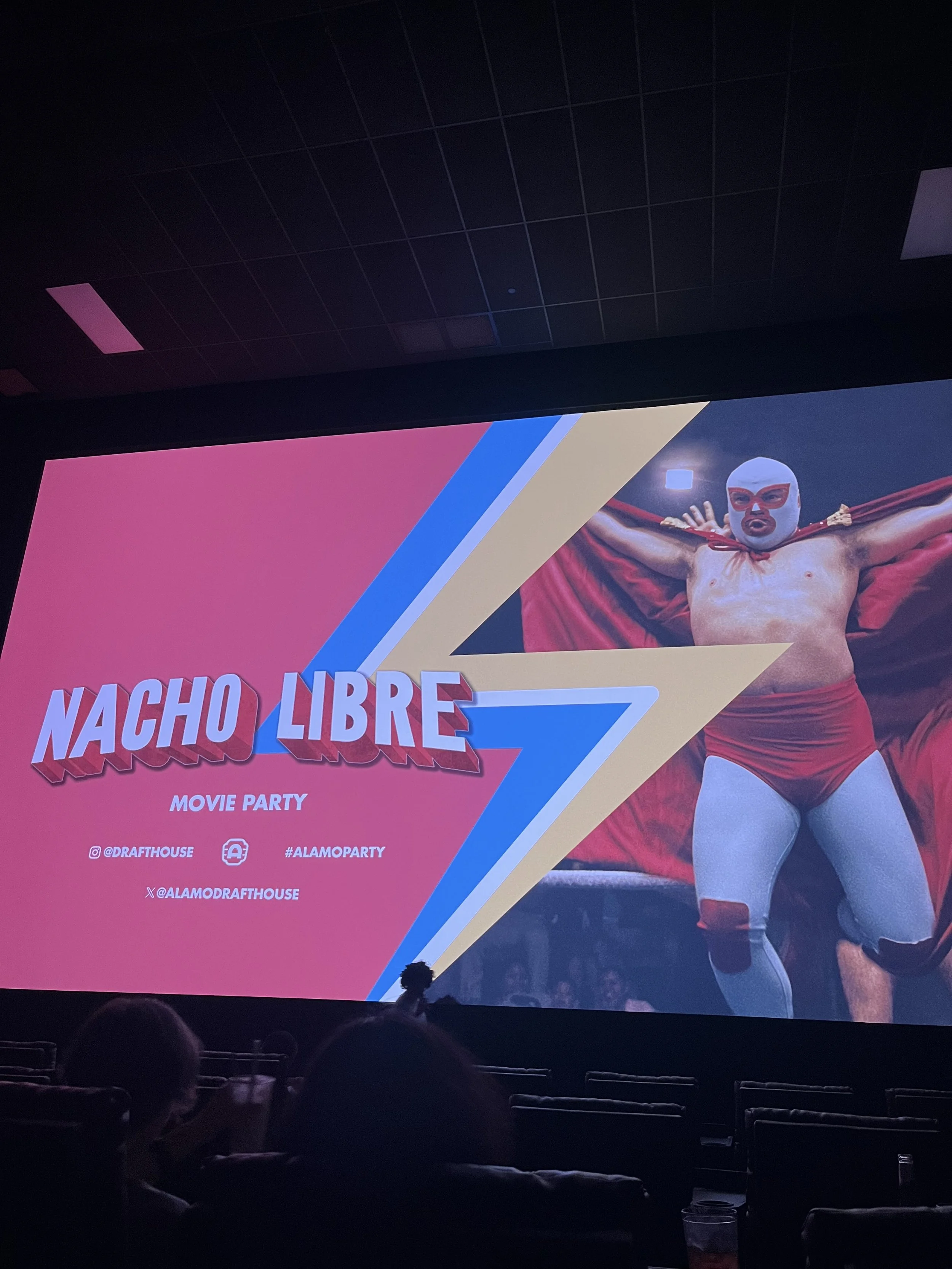
My first-ever screening of “Nacho Libre” in a theater. It did not disappoint.
Logan here.
Last month, we talked about my love of movies. There are some films that are very special to me, sacred even, that I have seen countless times since childhood. I would credit these movies with shaping my taste in movies as well as my sense of humor. One seminal film on this list is the 2006 comedy, Nacho Libre, directed by Jared Hess, (who also directed another very important film in Logan lore, Napoleon Dynamite). Earlier this month, Gia and I went to a special screening of Nacho Libre in honor of the movie’s 20th anniversary this year, and it was wonderful as always. I jokingly classify this movie as a Christian movie, and while it’s definitely not trying to be as in-your-face as something like God’s Not Dead, I’d like to posit that there is room to wrestle with biblical truth in this silly movie.
For the uninitiated, I’ll give you a brief recap of the movie. Ignacio, played by the incomparable Jack Black, is the cook at an orphanage in a small Mexican town. Being raised in the orphanage himself, he loves the children and has given his life to the work, but we meet him at a point where he feels disenchanted. He doesn’t have the resources for fresh ingredients, he gets pushed around by other friars, and is sent out on errands they don’t want. One night in the streets, Ignacio sees the best fighter in town, a lucha libre wrestler named Ramses, being flocked by people, getting all the praise. He then sees a poster for a local, small-stakes fight with a cash prize, and is enticed by the chance at money, fame, and to impress Encarnacion, the nun that just joined the orphanage. Over the course of the movie, Ignacio and Steven (a street urchin that Ignacio recruits to fight alongside him after an earlier bout between the two men over the orphans’ chips) fight in tag-team wrestling matches. Ignacio takes on the wrestling name Nacho and Steven becomes Esqueleto.
Unsurprisingly, they lose their first match, but still continue to train and fight, hoping that one day they’ll go pro and “get a little taste of the glory” as Ignacio puts it earlier in the movie. This dream seems like it will pan out for the two friends as they gain somewhat of a following. The glory comes with a cost, though: Ignacio has to hide his alter ego because, wrestling and the pride/idolatry that comes with it are frowned upon in the monastery. This leads to friction between Ignacio and Steven, because while they both want the glory and fame, Ignacio still has duties and responsibilities to the children, and he can’t meet these when he’s out trying to schmooze pro wrestlers like Ramses. Later, Ignacio faces Encarnacion and confesses his moonlighting as a wrestler. She encourages him to seek God’s forgiveness for his pride, vanity and secrecy, but also uplifts him: if he fights with a pure heart, for something noble or to help someone else, then God will be with him. So, he commits from then on to fight for the children, putting all his future winnings towards the orphanage. Perhaps by divine intervention, and, unbeknownst to Ignacio, a little scheming from Steven, he gets to fight in a one-on-one against the undefeated champ himself, Ramses. Ignacio puts up a valiant effort but still finds himself bested, until he sees Encarnacion and the orphans in the crowd, and finds the strength to defeat Ramses.
If you haven’t seen Nacho Libre and couldn’t tell from my plot summary, it’s a very fun, very goofy, but very heartfelt movie. For years, my Facebook bio read, “Nacho Libre changed the culture of Latin American comedies” because I love this movie and I was trying to be funny. While I have never had the credibility to make such a pretentious claim on the state of cinema, I think, as with all good stories, we can find some wisdom that points us back to the great Author of Life. The key theme I want to explore is the importance of seeking God’s glory rather than my own.
In church this week, we focused on the glory of God as demonstrated in the life of Christ. Our pastor referenced the Westminster Shorter Catechism from the 17th century Westminster Assembly. The first point of the catechism is the statement that “the chief end of man is to glorify God and enjoy Him forever.” Yet, human nature is bent towards seeking glory for self and enjoying whatever I want. While I have no desire to step into a wrestling ring, I certainly resonate with the desire for attention, validation and praise. Every time I write, especially with Writer on Wheels, I spend a lot of time trying to produce something that my readers will love. I want it to be funny, insightful and original every time. I set high standards, and while it challenges me creatively, it also leads to fear and frustration. Can I match the level of quality, vulnerability, and humor that I had in my first few posts? What if the jokes fall flat? What if there’s no mention of my disability? The blog is called Writer on Wheels, after all! What if I don’t make it spiritual, then am I honoring God? If I try to force a spiritual lesson, am I just trying to seem spiritual? If people don’t engage with my post, it must be lame. These are thoughts and questions I struggle with constantly. I believe it is a good thing to strive for excellence, and I am called to do so, but not for the world’s attention:
Whatever you do, work at it with all your heart, as working for the Lord, not for human masters,” (Colossians 3:23)
He has allowed me to “get a little taste of the glory” with this blog, as you all read, comment and encourage me. For that, I am grateful. Yet, the trouble comes when I anchor everything on your approval, dear reader. I get tied up in what I perceive you to think about my writing, and by extension, what you think about me. I stress, obsess and procrastinate, and as a result, don’t experience the joy and purpose to which I’m called. God has gifted me with skills and a calling to write, not for my own fame, but to bring people to Him, who is truly glorious. When Nacho was reminded who he fought for, he set his sights on his higher calling and found joy in victory. Keep training, keep fighting for good, keep caring for those around you, and against your own desires. God has placed you in a community, a family, a workplace, maybe even an orphanage or a wrestling ring to bring him glory and enjoy His goodness and love forever. His is the real glory!
“For our light and momentary troubles are achieving for us an eternal glory that far outweighs them all.” (2 Corinthians 4:17)